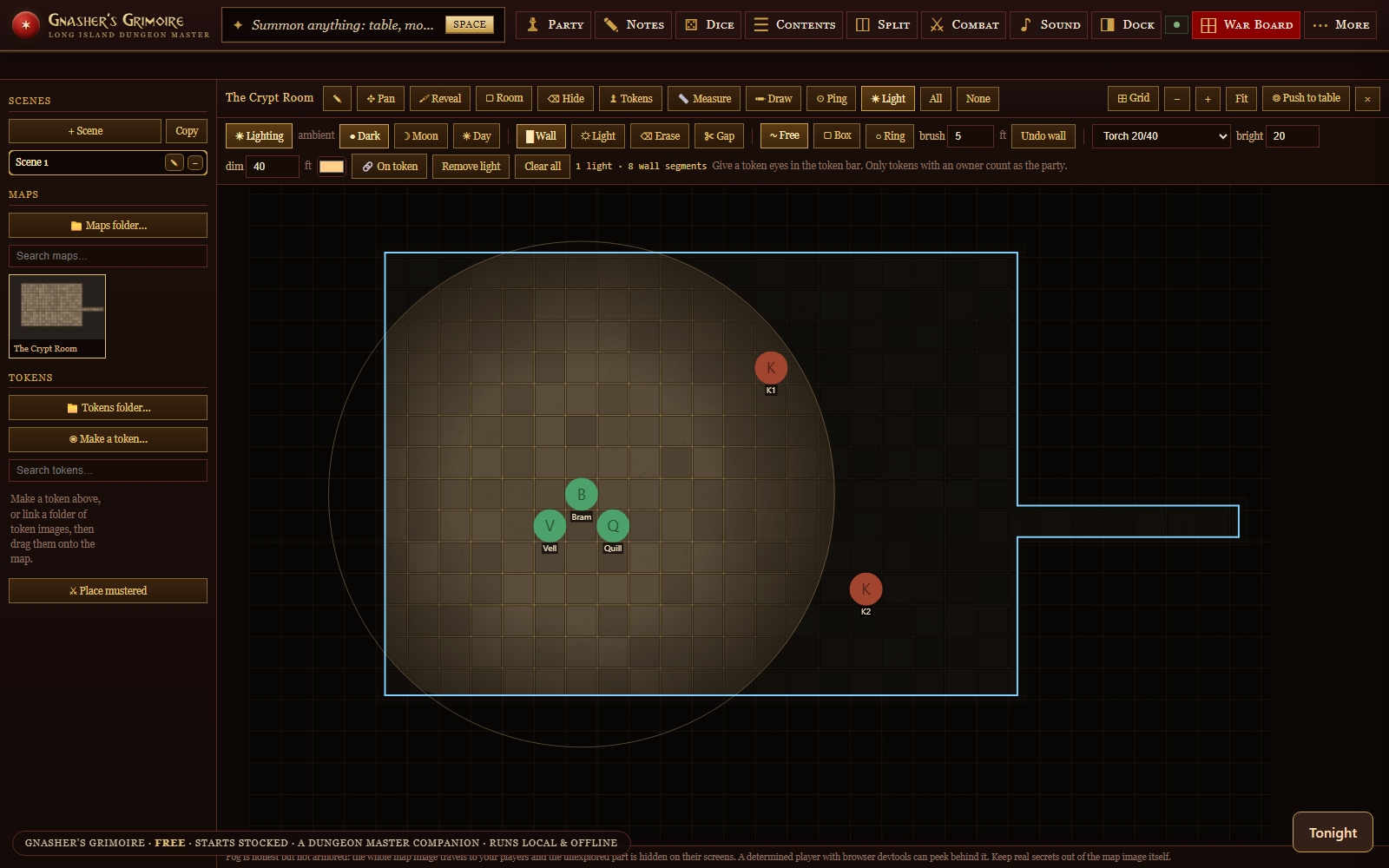
The Summon
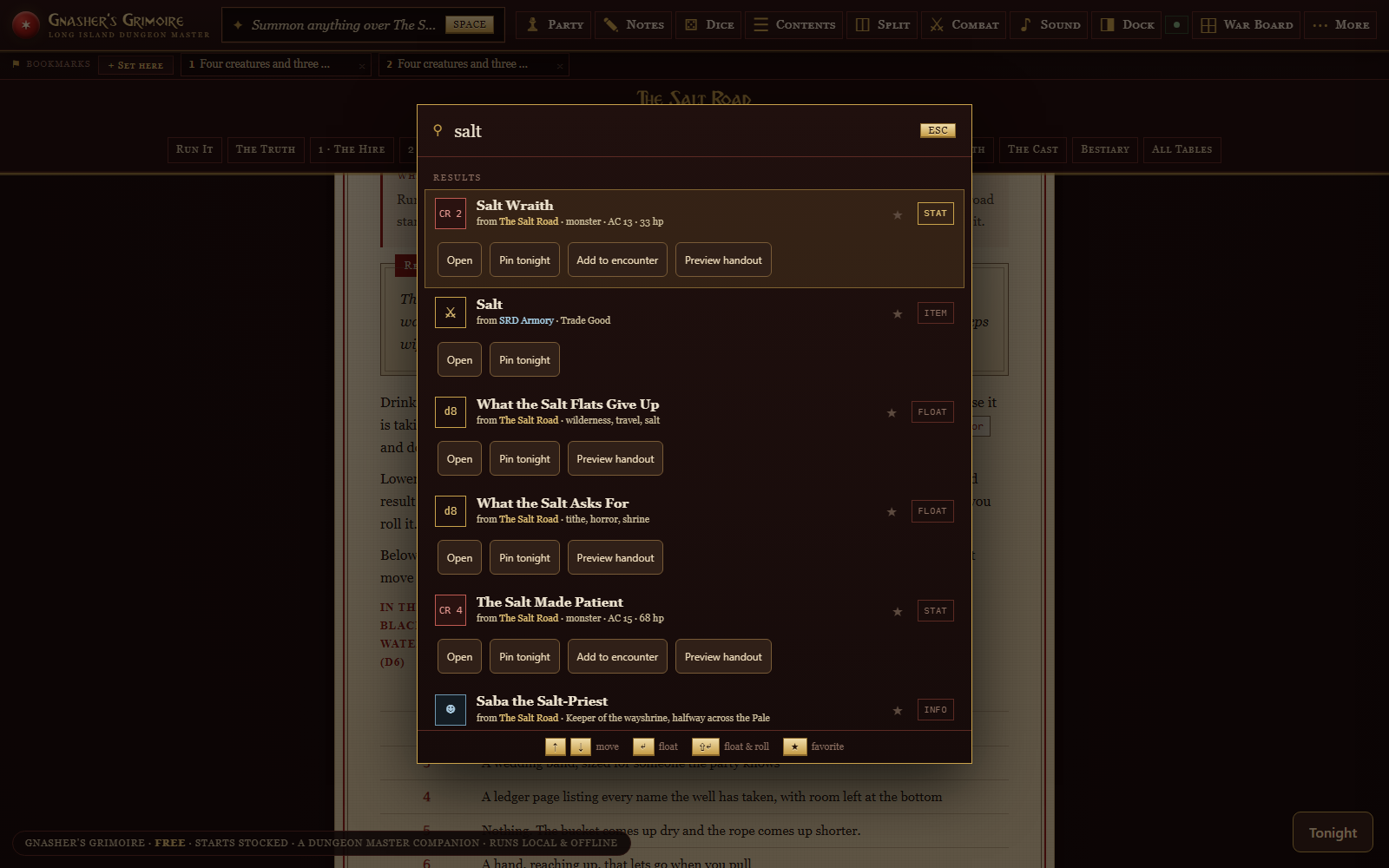
A command line over your whole library. Hit Space, type three letters, and tables, monsters, NPCs and pages from every book you own come up at once. Pick one and it floats over the scene you are running.
A digital DM screen
Gnasher's Grimoire is a digital DM screen. One file that opens in your browser and lays over the books you already own, with the whole night behind it. Your players join from their phones.
One file · opens in your browser · works offline forever · no account, no install · comes loaded with the full SRD 5.2.1: 335 monsters, 339 spells, 620 items, the rules
The same file, every build, is also a release on GitHub.
3.24.0 is out. The encounter card now grades a fight by odds that were actually rolled: five bands, from Walkover to Slaughter, out of 210,640 simulated fights. Creatures of CR 16 and up finally count. The simulator reads a creature's own spell list and weighs a breath weapon against its whole Multiattack. Every rating says how sure it is, and a question mark beside it says what kind of number you are looking at.
The live build, in motion. Space → type → the table floats over The Keeper of Halcyon Light → rolled in place. This is a recording of the real app.
A command line drops over whatever adventure you're running. Your scene stays exactly where it was.
"wol", "d100", a villain's name. It fuzzy-searches every book you own at once. Tables, monsters, NPCs.
The table lands on top of your scene. Roll it right there, read the result, move on. You never left your place.
Right now your adventures live scattered: a Keeper in your downloads, a free pack in your inbox, last week's one-shot in a folder you'll never find at the table. Gnasher's Grimoire is the slipcase that holds every one of them. Open the binder and it's all there: every table searchable, every monster one keystroke away, every NPC ready to speak.
Same instinct as the screen, everything you need in arm's reach, except the reach is three letters and a keypress, and it holds your entire library instead of four cardboard panels.
You're not buying a PDF you scroll.
You're buying a Keeper that drops into your Grimoire.
The moves you reach for mid-session, when you need something now and can't afford to lose the room.
A command line over your whole library. Hit Space, type three letters, and tables, monsters, NPCs and pages from every book you own come up at once. Pick one and it floats over the scene you are running.
Float as many cards as you want and drag them where you like. Collapse a big d100 down to its title bar. It still rolls collapsed. Everything saves to the exact adventure you opened it in.
Drop up to ten spots in a long adventure, auto-named from the scene you are on, so a bookmark you drop on the Gull’s Tooth battle map arrives already labelled. Click a chip and you are back there.
Muster a fight from your party and any monsters you own, then run initiative, HP and conditions without leaving the page. Attacks roll to-hit and damage into your log, a concentrating character who takes damage gets the DC, and a monster’s name plate hides from the players until they work out what it is. The muster and the fight, step by step.
Point it at your own folder of map images and run the fight on the map. Drop a grid on any picture or match the one it already has, pan and zoom, measure in squares and feet, draw on a layer your players never see, and ping a spot so every screen looks where you point. Press W. The War Board, step by step.
Drop an mp4 or a webm into the same maps folder and it opens on the board with a small film mark beside its name, playing under your grid, your fog, your lights and your tokens. Pause and the scrub beside it stop it and run it where you want. The animated map loops you already own drop straight in. A map that moves, step by step.
Trace the walls of a room and they block sight, with a gap brush for doorways and arrow slits. Then light the map the way the fiction does: a candle, a torch, a hooded lantern, a light spell or open daylight, each with its own reach. Every player token sees for itself, so the party only uncovers what it could see from where it stands. Fog paints back by brush, rectangle or eraser.
Keep several scenes on one board and change rooms in the middle of a fight without losing a token or redrawing a wall. Drop text notes anywhere on the map, kept to yourself or shown to the table. Your players can draw on the board too, so the rogue can sketch the plan everybody argues about.
Drop in a picture, or paste one off your clipboard, and the app punches it into a round token: pan it, size it, pick one of six borders drawn in the app. Conditions ride as a ring around the art instead of dots over it, and a monster you rename in the fight carries the new name everywhere.
The people at your table are in the muster beside your monsters. Tick a seat and it joins the order of battle as that character, with its own armour class and hit points, keeping the initiative they rolled on their own phone. Their row carries the body as the fight goes on: hit points, temp HP, armour class, concentration, conditions, and death saves as pips. A multiclass character reads Fighter 3 (Champion) / Wizard 1 everywhere it is named. Seats in the muster, step by step.
Your rolls land in the table's log beside everybody else's, marked as yours, with a natural 20 or a natural 1 called out and a hidden creature travelling as its number. A small hold on a card keeps that one roll behind the screen: it still lands in your own log, it just does not travel. What travels, step by step.
A panel is not a picture of your Grimoire. It is your Grimoire. Throw the War Board onto the television with its whole toolbar and run the fog, the tokens, the ink, the lights and the push from over there while your main monitor holds the book. Open New DM panel, name it, and pick what it shows; put two views in one window and they lay themselves out. DM panels, step by step.
The shared pile's money is five tappable coins, gold first: tap one, type a number, put in or take out, and a player can take as well as give through the same asking road an item takes. An offer across the table is marked on the sheet it came from with Take back beside it, expires on its own after ten minutes with both seats told, and every offer standing at the table is listed on your side with a Withdraw.
Read one code off the screen and your players link in with Gnasher’s Satchel. Muster a fight and initiative lights up every screen; push handouts and whispers; their rolls come home to your log. No server, no account. The table, step by step.
A shared pile the whole table reaches into. Players take from it, give to it and trade with each other, and none of it waits on you. Beside it runs the Table Thread: post a note, reply to it, drop a dice chip into a message that the sheet’s owner rolls for real. Freeze the thread when the night ends and keep it.
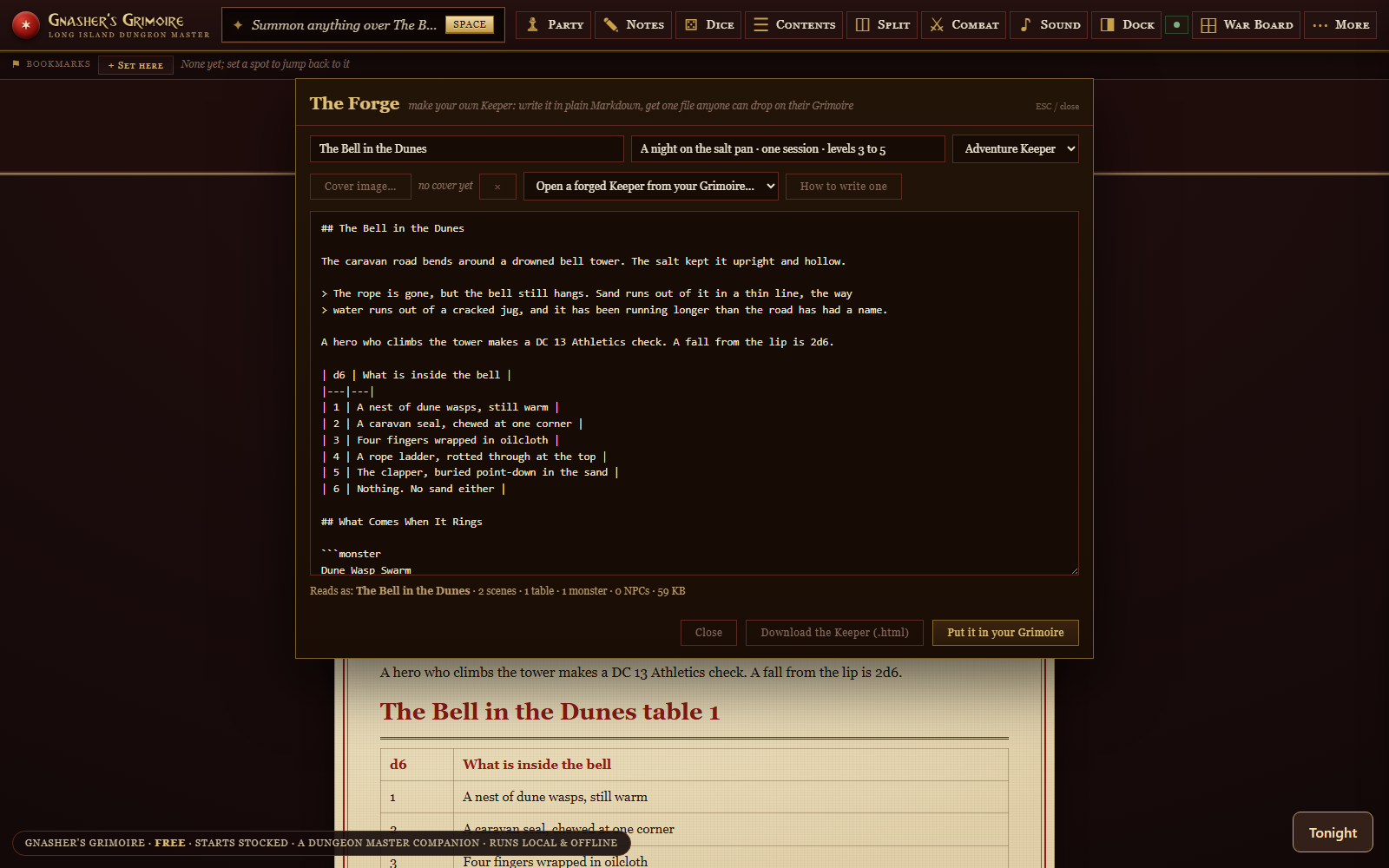
Write an adventure in plain Markdown, right in the app, and get a Keeper out. A ## heading starts a scene, a quoted line becomes read-aloud text, a table written with pipes rolls, and a pasted 5e stat block becomes a monster you can muster. Keep it, or download one file anyone can drop into theirs.
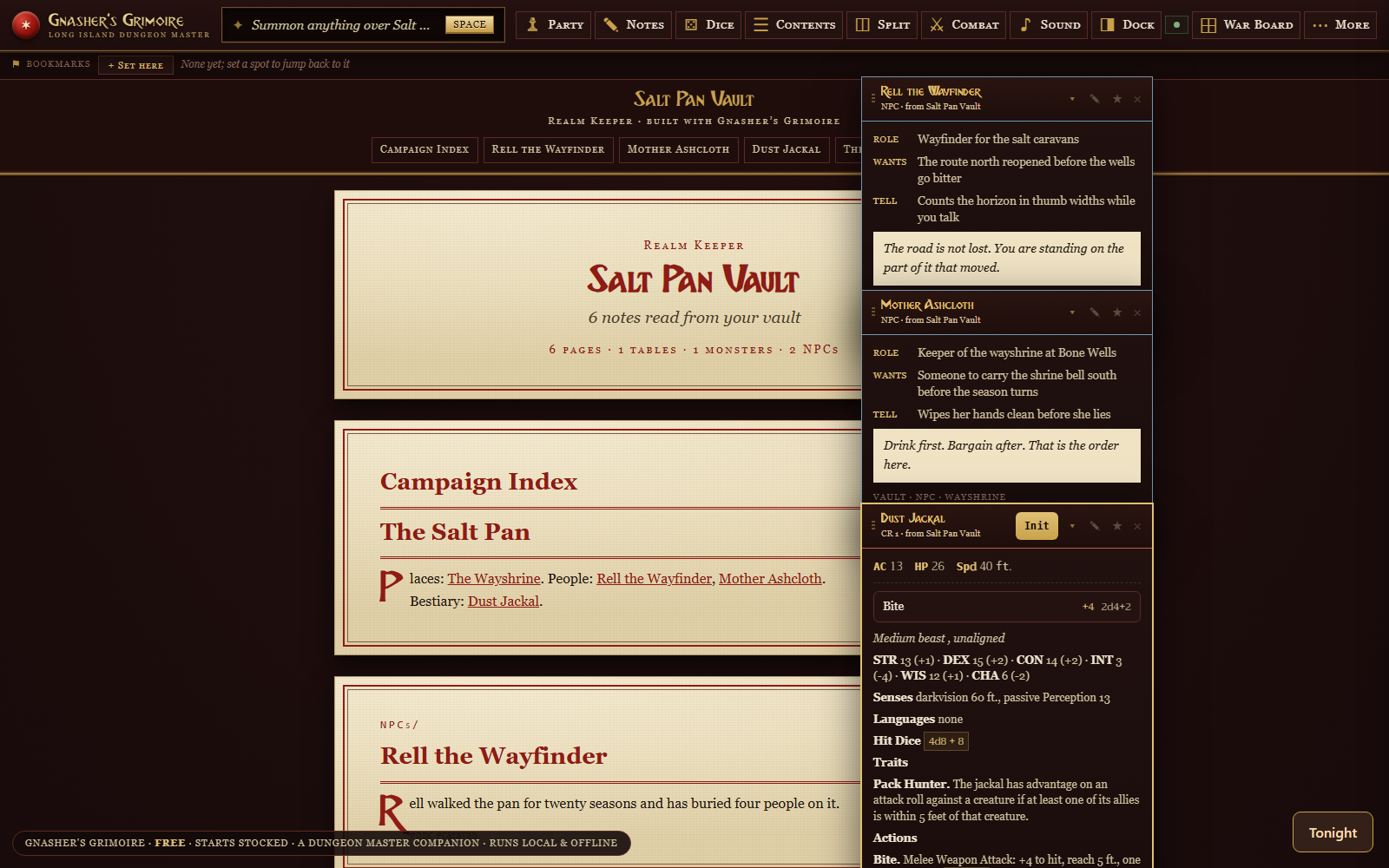
Point it at your vault and every note becomes a page and a card you can summon. Fantasy Statblocks blocks become monsters, Initiative Tracker encounters become encounter cards, notes tagged npc become NPC cards, tables roll and [[links]] still link. With a vault linked, tonight’s Chronicle writes itself back into it as a note. It asks before it reads, and again before it writes.
Drag a downloaded Keeper onto the binder and it is in. So are the tables you already typed: .docx, .xlsx, .csv, .tsv and Markdown, with the die read off your own roll column. No file at all? Paste the cells. Your .txt and .md notes come in with the pictures you embedded, and any phrase inside them is searchable.
Shelve your own .pdf books beside your Keepers, open them in the app, and set page marks. The Summon reads the words inside, so a phrase from page 200 finds that page. .epub books come in chapter by chapter, each one summonable. Nothing is uploaded.
The whole guide in one place: which files it takes, where they live on your machine, finding a phrase from page 200, page marks, searching one book instead of the shelf, and moving your library to another computer. Read it here.
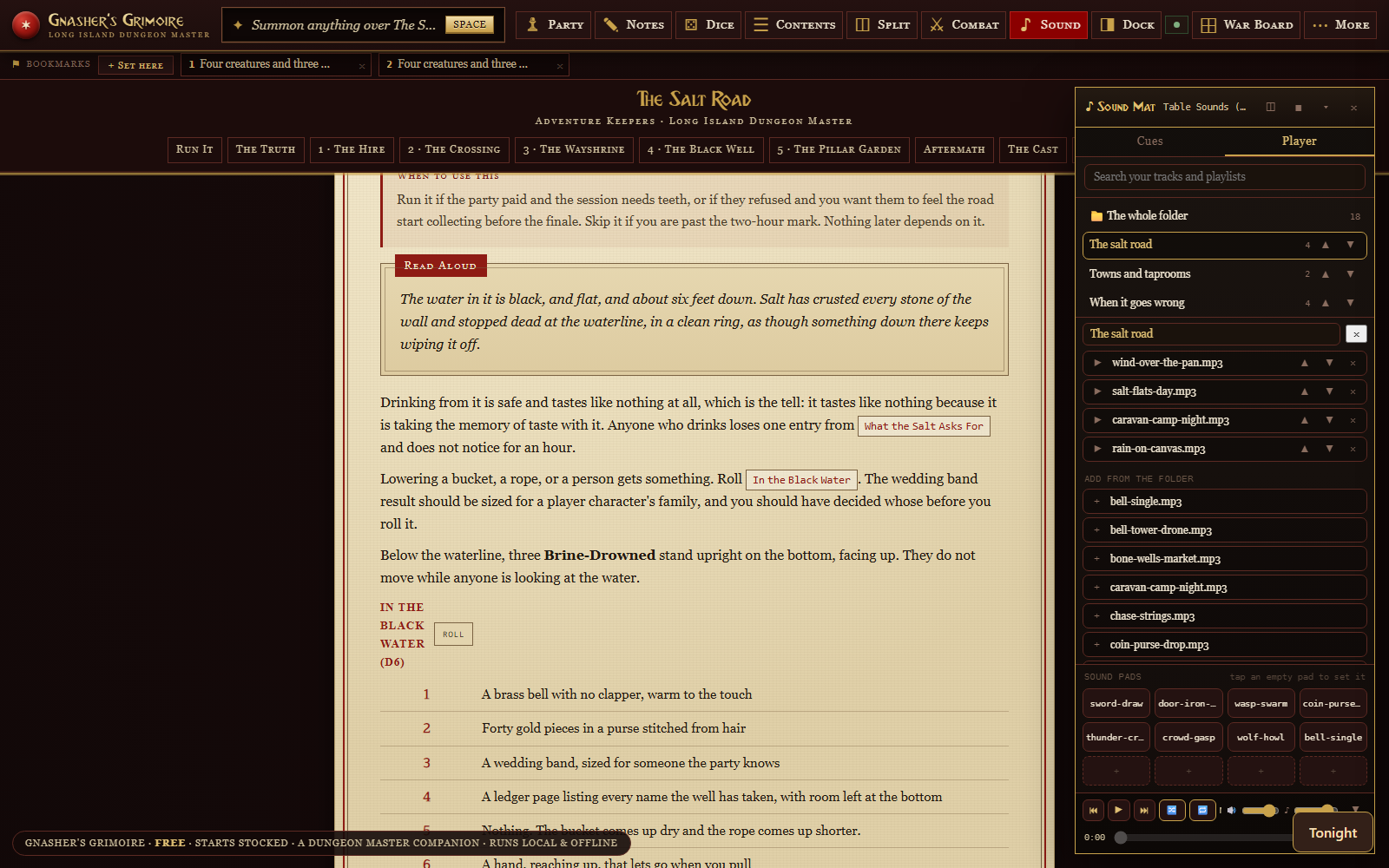
Put your music in a folder and play the night from the same screen: playlists, search, shuffle and loop as separate controls, and twelve one shot pads for doors, thunder and lockpicks. It sits beside the cue engine that plays a Sound Companion pack when an adventure calls for one.
For the question you did not prepare for: an NPC with a face, a manner and a want; names by culture; a tavern with a sign and a rumour; a shop with stock and prices; and loot. Reroll any single line until it fits, then drop the result into tonight’s Chronicle.
Retire any volume from its own cover, in three presses so it never happens by accident. The file on your computer is never touched and your notes and page marks stay put. Changed your mind? Restore the starting stock from About and every missing volume comes back, with nothing fetched from anywhere.
The pages read like a book on the desk: parchment, crimson rubrics and square rules, with the War Board and the fight screen staying dark where you want them dark. Seven colour packs, one a true black ground for a dark room, and seven figure faces so HP and AC read clean across the table. A step for the text size, and a plain reading mode for the long pages.
Drop in a picture of your realm or a dungeon level and place pins instead of tokens. A pin opens a note, a Keeper page, a few lines of text or another map. Hide what the party has not found, and drop a marker where they are standing. The ruler answers in miles.
Circle, cone, line and cube, placed off a token or any free point and sized in feet from the grid you already set. Keep one to yourself while you work out the reach, or share it and let the table see exactly what the fireball covers. It clears in one action.
Bind a playlist or a single track to any map or War Board scene. It starts when the map opens and fades when you leave the board, so changing rooms changes the room's sound without you reaching for the player. Or paste in an address, if your music lives on the web rather than in a folder on your disk.
Write up the night, read it over, and publish it to the table. It lands in every paired Satchel and stays there as campaign history, readable a week later with nobody at the table. A phone that was asleep gets it when it wakes. Notes, the thread and the recap, step by step.
Every NPC, place and piece of lore carries two bodies: the description the party may have, and the part that is yours. One key flips the view. Your half never reaches a Satchel until you reveal the record, and then only their half goes.
Name a dice formula on a Keeper or a combatant and it stays for the campaign; one click rolls it into the log. A place holds an ordered set of pictures too, so you flip through the gate and the hall and cast one to the party.
Set the board the night before: the map, the fog as you painted it, the tokens where you want them, the walls, the lights and the order of battle beside them. At the table it lays itself down and the fight opens at round one with the roster you prepared.
Send the board to a second window and drag it onto the television. It paints the players' half only: fog solid, your ink gone, a figure in the dark not drawn, no notes surface at all. The camera follows your pan, and initiative runs along the foot.
Press Screens and open the party view, the muster and the fight, your book, or the clock and the calendar, each in a window of its own. Put them on whichever monitors you have: the board on the television, the fight at your elbow. They follow the Grimoire as you work and come back where you left them. A window for every screen, step by step.
Your own months and month lengths, your own weekdays and moons, and the date pushed forward by days as the party travels. Paste in a table of months you already wrote and it is your calendar. The timeline sorts by the day in the world, so a thing they hear about late still lands where it belongs. The calendar and the clock, step by step.
Write down what is coming and your Grimoire tells you when you get there. Say when on a date, or simply in 3 days, or tap the day itself. Three days from now this NPC reaches the city, and the reminder pops when you have rested through it, with Mark done and Snooze a day beside it.
Tie any note to another from a fixed list: member of, leader of, allied with, enemy of, knows a secret of, gives a quest. The web draws out of the notes you already keep, and a name on it opens the record behind it.
What they heard, who said it, and where it stands: heard, chasing it, resolved, and round again as the party works it out. Drop one onto the timeline in a tap, so the thing they were told in a tavern keeps its place in the story.
A quest holds its giver, its reward, and sub-objectives that tick off one at a time, with the count in front of you. You can answer "how far along are we" without reading your own notes back at the table.
Click through the hours or drag a whole day past under one thumb. A short rest, a long rest and a day's march each move it by their own amount, the date rolls at midnight, and timed conditions and burning torches count down with it.
Dawn, day, dusk and night follow the clock, or hold one look instead: night, sepia, storm, the dark under the earth. Keep it to yourself or turn it to the table. Three plain starter maps wait in the tray too: parchment, stone and grass.
Hold a phone up to the screen and a character crosses as square codes the camera reads. No wifi, no cable, no account, and a four-character number on both screens saying the halves agree. The same door seats a player on your own network.
Drag the filled character sheet a player exported and read it straight into your roster. It names every box it took and every box it could not, and where two numbers could each be the score it takes neither and says why.
Eight steps for the night ahead, ticked off, kept in the binder and written into your Notebook. A five-room dungeon lays out its beats in a tap, and two dice answer how the thing you just met feels and whether what is left of it runs.
Narrow a search in the line you type it: cr:, level:, school:, book:, tag:, kind:, scoped to one book or everything you own. And twenty-five conditions and spell words carry a short plain note that opens where the word sits. Spells, rules and one box, step by step.
Muster the fight and press once: every monster rolls its own bonus, every player who rolled on their Satchel keeps their number, and round one has begun. Press an attack and you get both halves, 18 to hit (d20 13 + 5) and the damage behind it, with advantage in the turn bar and a natural 20 doubling the dice. The fight, step by step.
Every spell in a creature's spell list is a link. Hover it, or tap it on a touch screen, and the card comes up beside the name with the level, the range and the text. Press again for the whole card. A spell you have not got says so and names the pack that carries it.
Press Everything and every command in the Grimoire is in one menu, grouped by where it lives. Star the ones you want on the header bar, put them in your own order, and it remembers. On a phone the bar steps aside and everything lives in the menu.
On the War Board, press Book beside and the module you are running opens in a column next to the map, in that same press. The board keeps painting and your tokens keep moving. Drag the divider, or give the board the whole screen again. The War Board, step by step.
A player who loses wifi for a minute comes back as the same player, in the same chair, with their own character. Nobody is asked to sit down again as somebody new, and your roster never fills with people who are not in the room. Four phones can read the invite at once and all four get in. When the router will not let two devices in the room talk, press The router won't let us talk and pair by camera instead: nothing leaves the room on that road, so there is nothing for the network to block. Their screen says Reconnecting when a link goes quiet, and a table-night check reads four things fresh and says go or no go before anybody arrives. The live table, step by step.
Runs 100% offline, like the Keepers themselves. Your whole binder exports to one file you can back up or move, or you can link a folder on a drive and keep the binder in it: open the Grimoire on any computer, link the same folder, and your books, notes and saves are all there. No subscription to open what you already own.
Everything the Long Island Dungeon Master makes is a Keeper, a self-contained file built to drop straight into your binder. Some are here now; more are on the forge. Every one lands in the same Summon and the same War Table.
The Adventure Keepers Keepers by Other Authors
One Summon. One War Table. Your whole library, in reach. Free.
An Adventure Keeper isn't a file you skim. It's a playable adventure that loads into your binder and runs. A Creature Keeper isn't a stat-block PDF. Its monsters show up in the War Table, ready to fight. Own two Keepers and the Summon searches both. Own twenty and it searches twenty. The container is the value.
Whole open rulebooks, built as Keepers. Download one, drop it in your Grimoire, and every monster and spell in it is a keystroke away in the Summon, alongside everything else you own. No account, no sign-in, nothing phones home.
Which rules do they speak? The 2024 rules are built into the app already. Advanced 5th Edition and Black Flag arrive by pack, from the five above. Anything else that is 5e shaped comes in as your own file: .json in the 5eTools shape, a table in .docx, or a note in Markdown.
These are other people’s rulebooks, shared under the open licences their publishers chose, and each pack carries its own credit line inside it. We are not affiliated with any of these publishers. Your own books stay your own: the Grimoire reads a PDF you already have without ever uploading it.
Playing rather than running? The Player’s Satchel takes packs too, the same A5E feats and backgrounds, built so the character sheet actually uses them.
Already in the download · Run the fight on the map
The battle map most tables go looking for a subscription to get is already sitting in the file you downloaded. It opens on top of the adventure you are running, on your own folder of map images, and it works with the internet switched off.
New · Run the fight in place
The hardest part of a combat is never the dice. It's keeping the whole board in your head while the table watches you stall. The War Table runs it for you, right on top of the adventure.
New · Connect the whole table
You run the night from the Grimoire. Your players carry Gnasher's Satchel, the free character app, on their phones, tablets, or laptops. Pair once and the two halves lock together, with no server and no account.
Gnasher's Grimoire is free, and it always will be. It's the binder, and a binder only matters once there's something in it. What you fill it with is up to you. Load it with free Table Keepers from The Hoard, then fill it with the Bi-Weekly One-Shots and Keepers when you want more teeth. Own more, summon more. That's the whole deal.
New free content lands all the time, on the Substack and the socials.
Find them on itch.io.
No company, no investors, no ads, and nothing in the app calls home. It is one DM on Long Island, building the tool he wanted at his own table.
Two things keep it going. People buy Keepers, the adventures, tables and packs that drop into the binder. And people become Patrons, or donate.
Patron · $25, once. It unlocks nothing, because nothing is locked. The app is free today and it stays free, and there is no tier that opens a feature you already have on your disk. What it buys is art. Icons and covers get commissioned from artists, and this is what pays for them.
Screens from the live build. This is the app you're downloading.
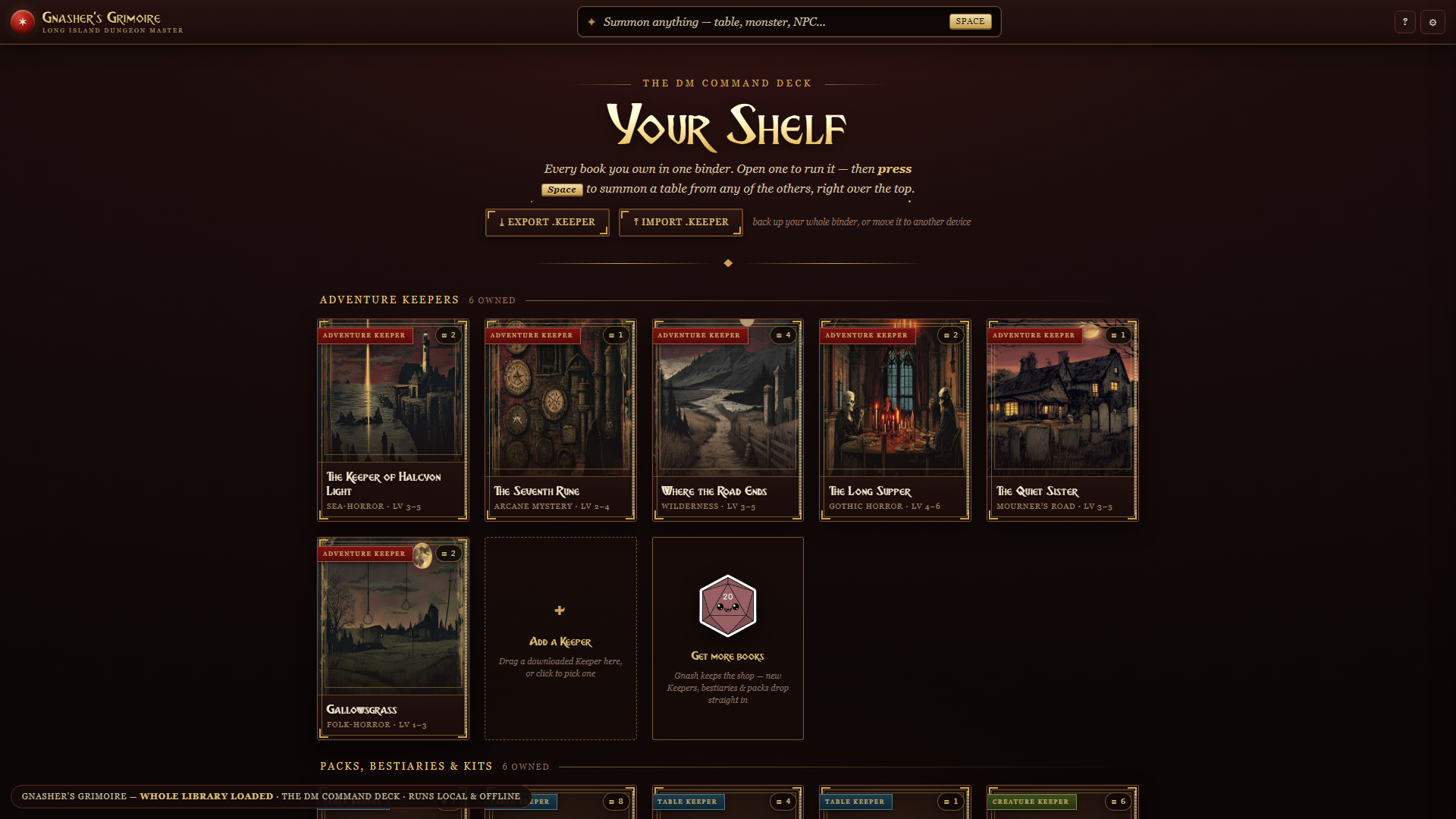
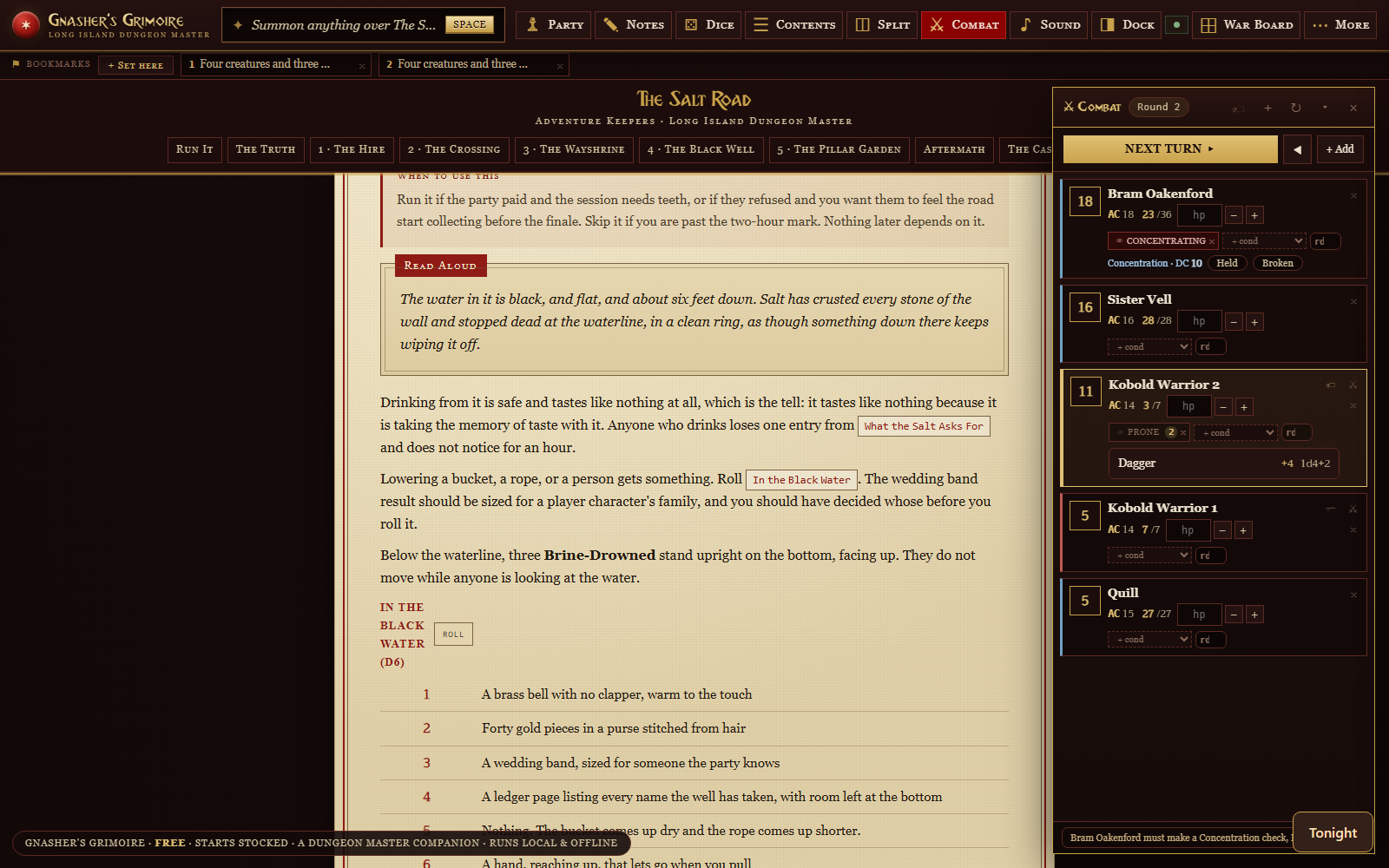
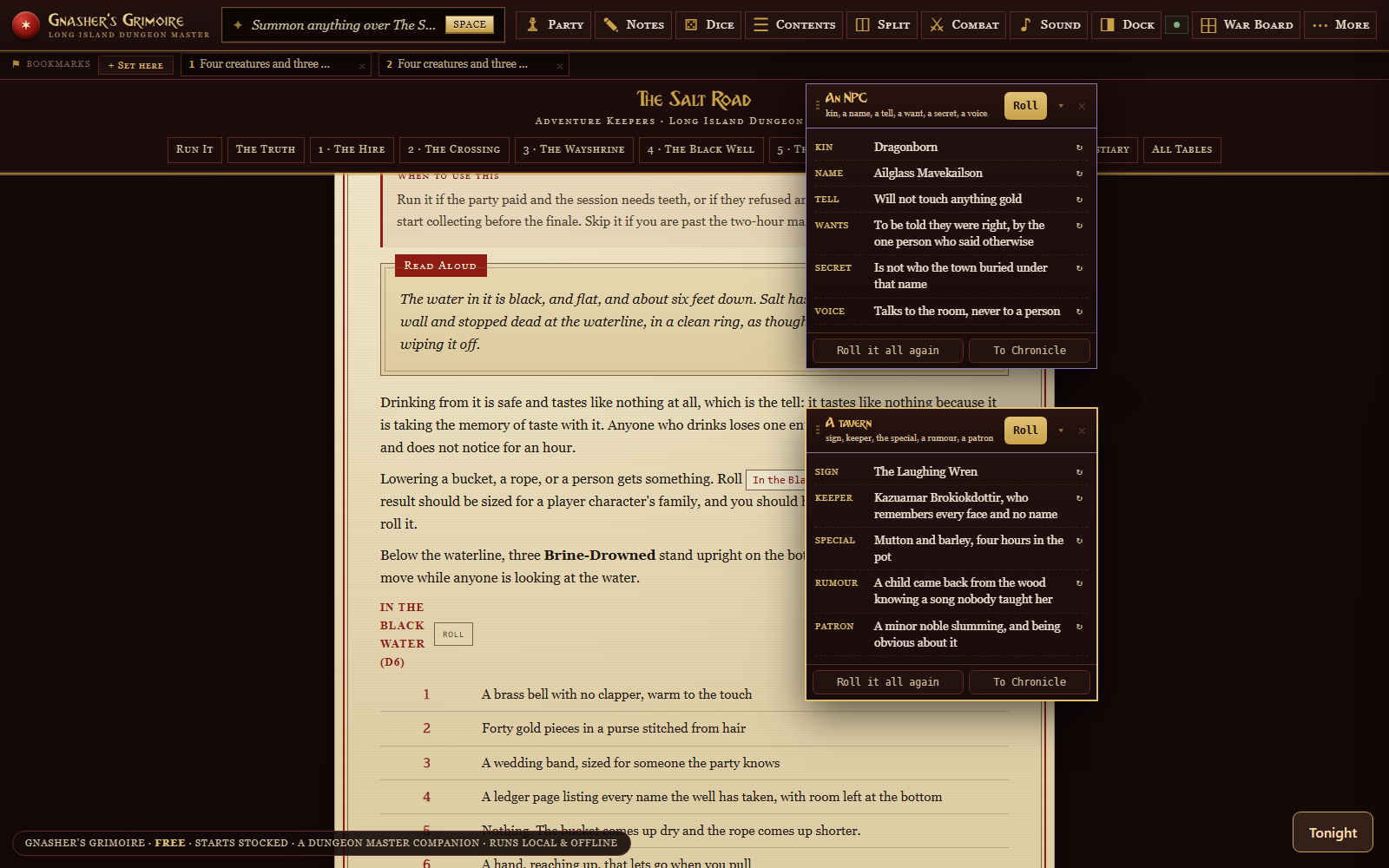
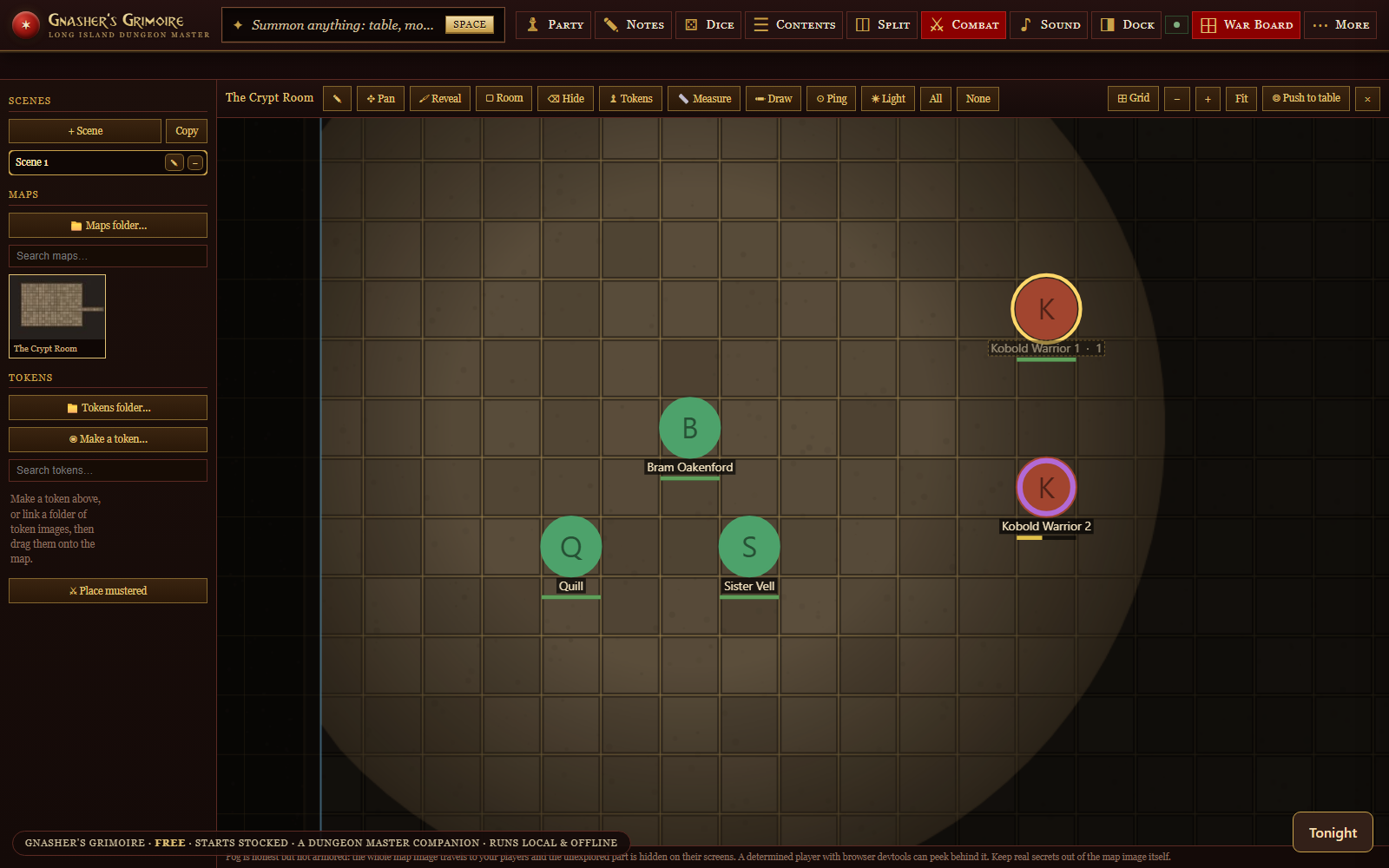
Gnasher's Grimoire is one file. Download it, double-click it, and you're holding a stocked binder: the full SRD 5.2.1 reference (335 monsters, 339 spells, 620 items, the rules, free under CC-BY-4.0), the DM's Field Kit, and a sample Adventure Keeper, all pre-loaded. Summon the Tarrasque from your very first keypress. No account. No install. No internet after this page. Then join The Bi-Weekly One-Shot and there's a new Keeper to feed it every other week.
Download Gnasher's Grimoire, free Join The Bi-Weekly One-Shot, freeWant to see what drops into it? Meet the Adventure Keepers (the self-contained adventures the Grimoire is built to hold) and the Keepers built from other authors' adventures, or grab free tools from The Hoard. Running in person? Here is my list of the free tools worth having at a physical table. Weighing the paid ones? what the subscription campaign tools actually cost.
The companion line: Gnasher's Grimoire™ (DM app) · Gnasher's Satchel™ (player app) · Gnasher's Quill™ (session recorder).
the Quill records → the Grimoire holds → the Satchel carries.
Something broken, confusing, or missing? grimoire@longislanddungeonmaster.com or the LIDM Discord. It goes to me, and bad news is the useful kind.