What each one costs, what its free tier includes, and what happens to your campaign if you stop paying. Every price below was checked in September 2026.
Most comparisons of these tools argue about features. That is the wrong argument. Every one of them can hold a campaign, and the differences between them are smaller than the marketing suggests.
A duller question matters more, because it only bites you later. What happens to five years of notes when a card expires, or a company gets bought, or you stop playing for eighteen months and come back? That answer is different for every tool here, and it is knowable in advance. So this list is organised around cost and ownership instead of feature counts.
Where a tool is better than mine, it says so. There is one on this page I would tell you to buy.
| Tool | What free gets you | Paid | If you stop paying |
|---|---|---|---|
| LegendKeeper | View and export your own projects; collaborate on other people's | $9/mo, or $7.50/mo billed $90/yr | Projects go read-only. Export is never paywalled |
| Foundry VTT | Nothing. It is a paid product | $50 once, perpetual licence including future updates | Nothing happens. You bought it |
| Owlbear Rodeo | 2 rooms, 200MB, and every tool including dynamic lighting | $3.99 or $7.99/mo for storage and rooms | You keep the free tier |
| Obsidian | Everything, for personal use | Optional paid sync and publishing | Your notes are Markdown files on your own disk |
| Gnasher's Grimoire | All of it | Nothing to pay | Not applicable. It is a file you already have |
A worldbuilding wiki with maps you can nest indefinitely, so you zoom from a continent down into a crypt and every pin opens a page. It has timelines and whiteboards, two people can edit a page at once, and it won an ENnie for best digital aid in 2024. It is good, and it is quick in a way screenshots do not convey.
The free tier is narrower than it sounds. Basic lets you view and export your own projects and collaborate on projects other people own. It does not let you create or edit a project of your own. Making anything means Pro, at $9 a month or $7.50 a month billed annually.
Two things to its credit, because they are the opposite of lock-in. Export is never paywalled, and it writes out to HTML or JSON as well as its own format. And when a subscription lapses the project goes read-only rather than dark, so the work is still there and still yours to pull out.
It works offline, which is not what most people assume about a browser tool, so here is their FAQ in its own words: "You can edit your wiki and atlas while offline, and the changes will sync up when you reconnect." The same FAQ is equally direct about the weak spot: "LK is not technically mobile-ready yet, but some people have had some luck with tablets."
Use it if you are building a world as a wiki, you want it to look good, and you want to share it.
This is the one I would tell you to buy. Fifty dollars, once, for a perpetual licence that includes future updates. Only the person running the game needs it.
If you play remotely or hybrid and you want a real virtual tabletop with lighting, automation and a modding community that goes deep, you pay $50 once and nothing free matches it for that job. A one-time price on software you host yourself is the shape everything else on this page is working around.
Use it if your table is online and you want depth. It is not what you want for four people around a kitchen table.
A shared battle map your players open on their own phones, with no account needed for them. The free tier gives you two rooms and 200MB, and unusually it does not hold features back: dynamic lighting and every tool are included on the free plan. The paid tiers at $3.99 and $7.99 a month buy storage and rooms, not capability.
Use it if you want a map everyone can see without thinking about it. It needs a connection, and that is the trade.
Not a D&D tool at all, which is exactly why it belongs here. Free for personal use, and your notes are plain Markdown files in a folder on your own disk. Nothing you write is trapped in anyone's product, now or in ten years.
The trade is real. You get a better writing tool and you assemble the game-shaped parts yourself: no encounter builder and no initiative tracker. Most people solve that by pairing it with something that runs the session.
Use it if the thing you most want to protect is your writing.
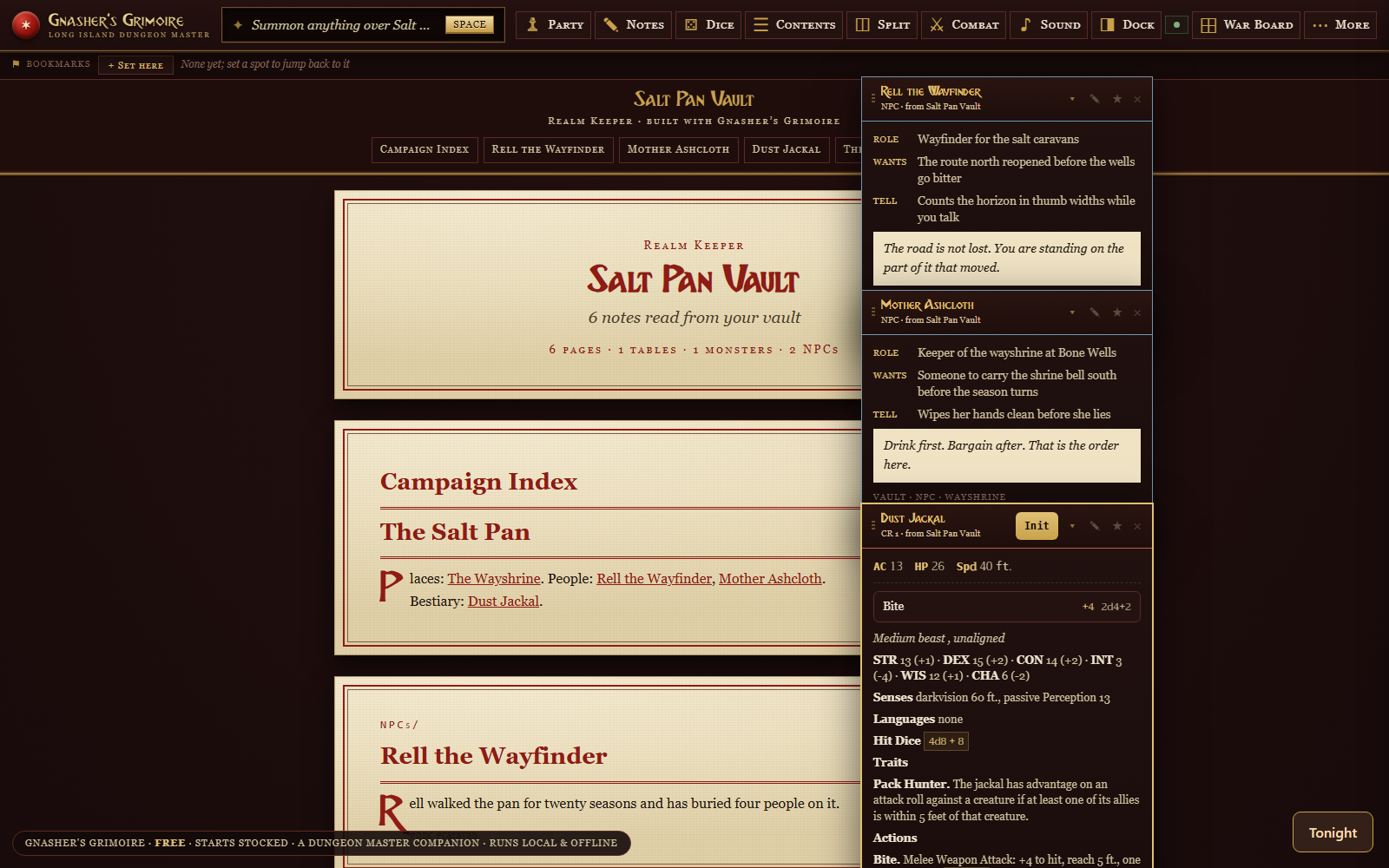
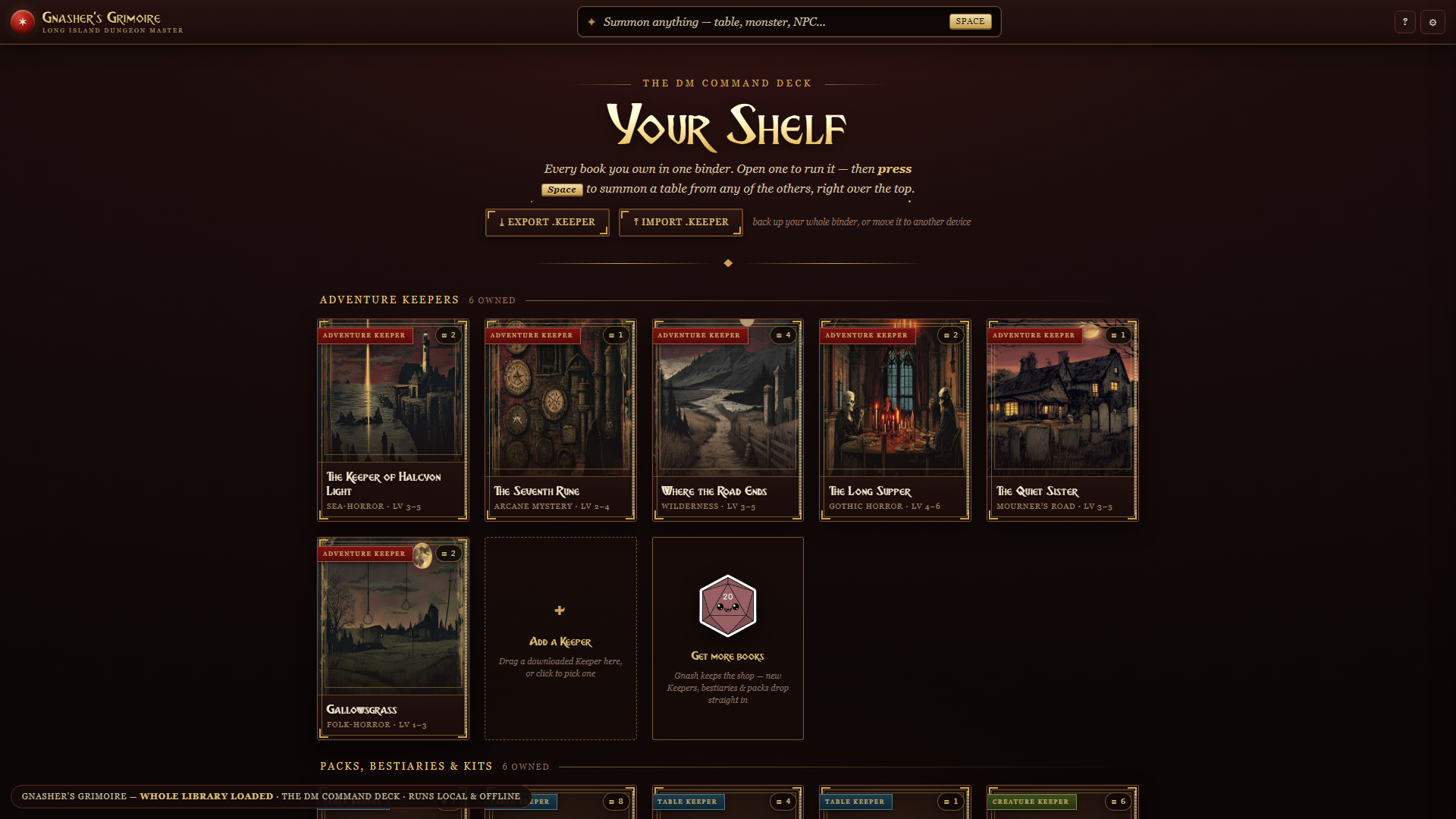
Mine, so read this knowing that. It is a Dungeon Master's companion that is one HTML file: no install, no account, no server, and it runs with the network off. It holds the adventures and rulebooks you already own, reads PDF, EPUB, Word, Markdown and more, and makes every table, monster and rule inside them searchable in one place. It tracks a fight and runs a battle map, and it plays audio out of a folder of your own files. It reads an Obsidian vault directly, which is why the pairing above is worth mentioning.
What it is not. It is not a worldbuilding wiki: there are no nested maps or timelines, and if that is what you came for then LegendKeeper does it far better. It is not a remote virtual tabletop either, and if your players are not in the room, Foundry or Owlbear Rodeo is the right answer instead of this.
Use it if your table is in one room and you want everything you own in one place that keeps working when the wifi does not.
Free always costs something:
If you use the part you are paying for, yes. LegendKeeper at $7.50 a month is cheap for someone who builds worlds as wikis. It is expensive for someone who opens it twice a year. The test is whether you used it last month rather than whether you might.
It depends on the tool, and you should check before you commit. LegendKeeper turns projects read-only and never paywalls export. Foundry is a one-time purchase, so nothing happens at all. The case worth worrying about is any tool that stores your work in a format you cannot export.
More than you would expect. LegendKeeper's own FAQ says you can edit offline and it syncs when you reconnect. Obsidian is local by default. Gnasher's Grimoire is a single file that never needs a connection. Owlbear Rodeo does need one, because the whole point of it is a shared live map.
That is what most people end up doing and it is usually the right answer. A common pairing is Obsidian for writing and a separate tool for running the night. Gnasher's Grimoire reads an Obsidian vault directly for exactly this reason.
Whichever one you will still be using in three months, which usually means the one with the least setup. Do not buy anything for your first few sessions. Start free, find out what slows you down at the table, then pay for that specific problem if a paid tool solves it.